By Dr. Nikhil Puri | Plastic & Cosmetic Surgeon, Lucknow
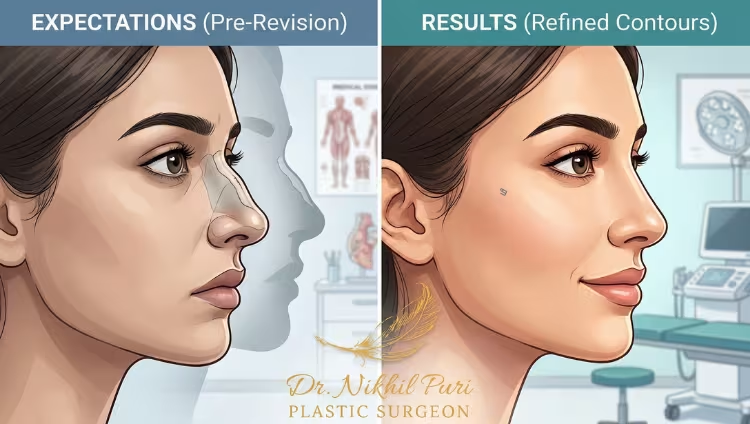
Most blogs about revision rhinoplasty give you a neat, clean picture. They say things like “expect refinement, not perfection” and then stop there. But the real story is longer, messier, and much more important for you to understand before making any decision.
This blog tells you what most surgeons won’t say publicly — but what every patient truly needs to know.
What Most Blogs Get Right (But Don’t Go Deep Enough)
Almost every article out there covers the basics:
Revision rhinoplasty is more difficult than the first surgery. Scar tissue gets in the way. You may need more than one surgery. Choose an experienced surgeon.
All of that is true. But it’s only the surface.
What they don’t tell you is this: the nose has a memory. Cartilage runs out. Results can actually look worse between months 9 and 18 — not months 1 to 3. And perfect symmetry? It’s not really possible, and nobody wants to say that out loud.
This blog goes deeper.
What Really Happens During Revision Rhinoplasty
Think of revision rhinoplasty like this: you are trying to fix an old building using whatever materials are left over. The foundation is weaker. The tools are fewer. And the work is harder.
Scar tissue is not a simple problem
Every blog says “scar tissue makes it harder.” True. But here’s what they skip: scar tissue behaves differently in every patient. It changes for months after surgery. It can tighten in unexpected ways. It can pull a perfectly placed graft out of position. And most importantly, scar tissue remembers the old shape of the nose and constantly tries to go back to it. Surgeons fight that memory with every revision case.
Cartilage supply is limited — and it runs out
Your first nose surgery likely used cartilage from your nasal septum. Maybe some from your ear. By the time you come in for a revision, much of that may already be gone. That means the surgeon has to look at rib cartilage — which is a bigger step, with bigger recovery, and its own risks of warping over time.
When there isn’t enough cartilage, the tip of the nose loses its shape, breathing becomes harder, and the structure becomes fragile. This is one of the most important things your surgeon will check in a consultation.
The nose wants to go back to how it was
Just like teeth shift back after braces are removed, the nose has a natural tendency to return to its previous shape. If this tissue memory is not planned for, the tip droops over time, the bridge widens, and the overall result fades. This is biology — not a surgical mistake.
The Timeline of Results: What Nobody Explains Clearly
This is where most patients get confused — and most blogs stay quiet.
REVISION RHINOPLASTY RESULTS TIMELINE
| Time Period | What’s Happening | What Patients Feel |
|---|---|---|
| Month 1–3 | Swelling hides everything | Optimistic, relieved |
| Month 3–6 | Swelling reduces, early results show | Cautiously hopeful |
| Month 6–12 | Scar tissue contracts, real shape emerges | Often disappointed |
| Year 1–2 | Cartilage settles, grafts shift, final result | True outcome visible |
| Year 2+ | Long-term structural changes possible | Stability tested |
Most patient dissatisfaction happens between month 6 and 12 — not in the first few weeks. This is when the swelling is gone, the scar tissue has tightened, and what you see is much closer to the permanent result. Graft edges can become visible. Slight asymmetry increases. Breathing may feel slightly different again. This phase is real, and it’s important you know it’s coming.
4 Big Myths About Revision Rhinoplasty
Myth 1: “Revision will finally give me the nose I always wanted.”
Not always. Sometimes the structure of your nose simply cannot support the shape you want. A good surgeon will prioritize stability over appearance in those cases. That’s not a failure — that’s the right decision.
Myth 2: “Small changes are easy.”
Actually, the opposite is true. In a first surgery, making a centimetre of change is relatively straightforward. In revision surgery, moving even a millimetre requires far more planning, skill, and risk management.
Myth 3: “A better surgeon can fix what the first one couldn’t.”
Skill matters, yes. But revision surgery is not just about the surgeon’s ability. It’s about what materials are available to work with. If the cartilage is gone and the tissue is scarred, even the best hands in the world face real limits.
Myth 4: “I can get a perfectly symmetrical nose.”
No one’s face is perfectly symmetrical. Skin thickness, lighting, and natural facial anatomy all create the appearance of slight differences. Under skin, achieving true symmetry is not physically possible. A good result means significant improvement — not mathematical perfection.
Cases That Need Extra Honest Conversation
When your skin is very thin
Thin skin shows every tiny irregularity underneath — every graft edge, every small contour change. If you have thin skin and very high expectations, your surgeon must have a frank conversation with you before proceeding.
When the nose has been operated on multiple times
After three or more surgeries, the situation becomes genuinely complex. Cartilage is depleted. Skin may be thin and fragile. Blood supply to the area may be reduced. In these cases, the surgeon’s primary goal shifts from improving appearance to preventing collapse. Sometimes, the most responsible answer is to not operate again.
The emotional and psychological side
This is the part nobody writes about. Many patients coming for revision surgery are dealing with anxiety, mistrust from previous experiences, or an intense focus on small imperfections that others don’t even notice. This is not a criticism — it’s a real clinical consideration. A surgeon who ignores this part of the picture is setting everyone up for disappointment.
What Can Go Wrong — And Why
If scar tissue tightens too aggressively, the nose can narrow too much, the bridge can dip, and breathing can worsen. If the cartilage graft warps after surgery, the nose becomes asymmetrical in new ways. If revision is done too early — before one full year of healing — the surgeon is working in active scar tissue, which is the most unpredictable and risky environment possible.
And if expectations are not reset before surgery, no result will feel satisfying — no matter how technically well it goes.
How Surgeons Actually Define Success in Revision Cases
Success in revision rhinoplasty is not a perfect nose in a photograph at three months. Real success looks like this:
The structure is stable. Healing is predictable. Breathing has improved or stayed the same. The deformity is reduced. The patient was emotionally ready going in. And the result holds up over years, not just weeks.
The Surgeon’s Dilemma: Pretty vs. Strong
In complex revision cases, surgeons often face a real choice: do we pursue the most aesthetically pleasing result, knowing it may not hold up structurally over five years? Or do we build something slightly less refined, but structurally solid enough to last twenty years or more?
This is a real conversation that happens in every serious revision case. The honest answer isn’t always what the patient hoped to hear. But it is always the right answer.
5 Frequently Asked Questions
Q1. How long should I wait before getting revision rhinoplasty?
You should wait at least 12 full months after your previous surgery. This is not just a general guideline — it is because scar tissue takes that long to fully mature. Operating earlier means working in unpredictable, active scar tissue, which significantly increases the risk of a poor outcome.
Q2. Will revision rhinoplasty fix my breathing problems?
It may, but not always. Breathing issues after rhinoplasty can come from structural collapse, scar tissue, or changes in the internal passages. Your surgeon will evaluate your specific situation. Improvement is often possible, but it depends on how much structural support remains.
Q3. I’ve had two surgeries already. Can I still get another revision?
It depends on what cartilage is left, how your skin has healed, and what your nose looks like structurally. After multiple surgeries, options become more limited. Your surgeon will need to do a thorough evaluation before determining whether another revision is safe and likely to improve your situation.
Q4. Why does my nose look worse now than it did right after surgery?
This is actually common and has a name — it’s called the “unmasking phase,” and it typically happens between months 6 and 12. As swelling resolves completely, scar tissue contracts, and cartilage settles, the true shape of the revision result becomes visible. If this looks different from what you saw at month 3, it’s because month 3 wasn’t the final picture.
Q5. How do I know if my expectations are realistic?
The best way is a detailed, honest consultation with an experienced revision rhinoplasty surgeon. A good surgeon will not just show you before-and-after photos — they will examine your cartilage supply, skin thickness, scar tissue status, and healing history, and then tell you honestly what range of outcomes is realistically possible for your specific nose.
Ready for an Honest Conversation About Your Nose?
Revision rhinoplasty is not a simple fix. It requires experience, honesty, and a surgeon who will tell you what you need to hear — not just what you want to hear.
Dr. Nikhil Puri is a specialist Plastic & Cosmetic Surgeon based in Lucknow, with deep expertise in revision rhinoplasty and complex nose reconstruction. He believes every patient deserves a clear, transparent understanding of what surgery can and cannot achieve for them — before any decision is made.
If you have concerns about a previous rhinoplasty or simply want an honest second opinion, book a consultation with Dr. Nikhil Puri today.
Your nose. Your decision. The full truth — always.