Reviewed by Dr. Nikhil Puri | MCh Plastic Surgery
Wondering How Much a Hair Transplant Costs in Lucknow?
Hair loss is more than a cosmetic concern—it can affect confidence, self-image, and even the way people interact socially. Every week, I meet patients in my clinic who ask the same question:
“Doctor, what is the actual Hair Transplant Cost in Lucknow?”
Many have already searched online and received completely different estimates. One clinic advertises a procedure for ₹30,000, while another quotes over ₹1,50,000 for what appears to be the same treatment. Naturally, this creates confusion.
The reality is that hair transplant cost in Lucknow is not fixed. Every patient has a different degree of hair loss, donor hair quality, scalp condition, and long-term treatment goal. Because of these differences, two people rarely receive the same treatment plan or the same quotation.
Another common question patients ask is whether the Hair Transplant Cost in India is lower than in metro cities such as Delhi, Mumbai, or Bengaluru. In many cases, the answer is yes. Lucknow has become a preferred destination for hair restoration because patients can access experienced surgeons, modern surgical facilities, and advanced techniques while often paying less than in larger metropolitan cities. However, choosing a clinic based only on price is rarely the right decision, as surgical expertise and patient safety have a significant impact on long-term results.
As a plastic surgeon, my advice is always the same: don’t compare only the price—compare the surgeon, the planning, the safety standards, and the quality of care. A hair transplant is a permanent surgical procedure, and proper graft planning today can influence how your hair looks even 10–20 years from now.
In this comprehensive guide, you’ll learn everything you need to know about Hair Transplant Cost in Lucknow, including average pricing, graft-wise costs, factors that affect the final estimate, available techniques, recovery, and practical tips to help you make an informed decision before choosing a clinic.
Why Do Hair Transplant Prices Vary So Much?
One of the biggest misconceptions is that every hair transplant should cost the same.
In reality, pricing depends on several medical and surgical factors, including:
- Number of grafts required
- Severity of hair loss
- Quality of the donor area
- Hair transplant technique (FUE, FUT, or other advanced methods)
- Surgeon’s expertise and experience
- Operating theatre facilities
- Post-operative care and follow-up
For example, a patient requiring 1,200 grafts for a receding hairline will naturally have a different treatment plan and cost than someone requiring 3,500 grafts to restore both the front and crown.
This is why a proper consultation is always the first step before discussing the final treatment cost.
What Is a Hair Transplant?
A hair transplant is a minimally invasive surgical procedure that restores hair growth by relocating healthy hair follicles from one part of the scalp (known as the donor area) to areas affected by hair thinning or baldness (known as the recipient area).
Unlike temporary solutions such as hair fibres, wigs, or patches, a hair transplant uses your own natural hair follicles. Once the transplanted follicles heal and begin growing, they continue to grow naturally, allowing you to wash, cut, and style your hair just like the rest of your scalp.
Modern hair transplant techniques have made the procedure safer, more comfortable, and capable of producing highly natural-looking results when performed by an experienced surgeon.
Who Is an Ideal Candidate for a Hair Transplant?
One of the biggest misconceptions is that everyone experiencing hair loss requires a hair transplant.
In reality, surgery is recommended only after a detailed scalp examination and hair loss assessment.
During my consultations, I first try to understand why the patient is losing hair before recommending surgery. In some individuals, medications or lifestyle modifications may slow hair loss and delay the need for a transplant. For others, surgery may provide the most effective long-term solution.
Generally, you may be a suitable candidate if you:
- Have male pattern baldness (Androgenetic Alopecia)
- Have a stable pattern of hair loss
- Possess a healthy donor area at the back or sides of the scalp
- Are above 25 years of age in most cases
- Have realistic expectations regarding the outcome
- Are in good overall health
A consultation with an experienced surgeon is essential because the success of a hair transplant depends not only on the number of grafts but also on careful patient selection and long-term planning.
My Approach to Hair Transplant Planning
One question I frequently hear from patients is:
“Doctor, how many grafts will I need?”
The answer is different for every individual.
Rather than estimating grafts by looking at photographs or online calculators, I evaluate several important factors during the consultation, including:
- Pattern and stage of hair loss
- Donor hair density
- Hair thickness
- Hair texture
- Scalp laxity
- Family history of baldness
- Future progression of hair loss
Many patients request the maximum possible number of grafts in a single session. However, preserving the donor area is equally important because it is a limited resource.
My goal is not simply to transplant the highest number of grafts but to create a natural-looking hairline while ensuring enough donor hair remains available for future needs if required.
Hair Transplant Cost in Lucknow: 2026 Price Overview
One of the primary reasons patients search for Hair Transplant Cost is the wide variation in prices advertised by different clinics.
While some centres promote extremely low-cost packages, others charge significantly higher fees.
The difference usually depends on several factors, including the surgeon’s expertise, the transplant technique used, the complexity of the procedure, and the quality of post-operative care.
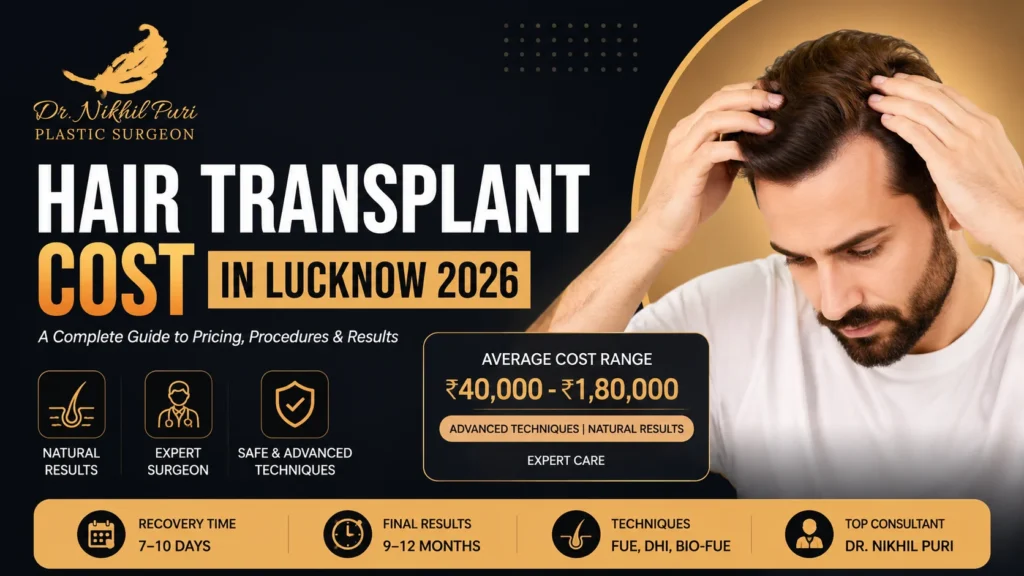
In most reputed clinics, the Hair Transplant Cost in Lucknow generally ranges between ₹35,000 and ₹1,80,000, depending on the individual treatment plan.
Patients requiring fewer grafts for hairline correction usually fall at the lower end of the price range, whereas extensive baldness requiring multiple grafts naturally involves higher costs.
Hair Transplant Cost in India Compared to Lucknow
Many patients from nearby cities such as Kanpur, Ayodhya, Prayagraj, Gorakhpur, Sitapur, and Bareilly visit Lucknow because they can access experienced surgeons and advanced treatment facilities without paying the significantly higher consultation and procedural costs often associated with metropolitan cities.
The average Hair Transplant Cost in India generally ranges between ₹30,000 and ₹2,00,000, depending on the city, clinic, surgical technique, and graft requirement.
While metro cities may charge a premium due to higher operational expenses, patients in Lucknow often receive comparable medical expertise and modern surgical care at a more affordable overall cost.
However, choosing a clinic solely because it offers the lowest price is not advisable. A successful hair transplant depends on careful planning, proper graft handling, sterile surgical techniques, and the experience of the operating surgeon rather than price alone.
What Factors Affect Hair Transplant Cost in Lucknow?
One of the most common misconceptions is that hair transplant cost depends only on the number of grafts. While graft count is an important factor, several medical and technical aspects influence the final treatment cost.
Understanding these factors helps patients make informed decisions instead of choosing a clinic based solely on the lowest price.
1. Number of Grafts Required
The biggest factor affecting the Hair Transplant Cost in Lucknow is the number of grafts needed to achieve natural-looking results.
For example:
| Hair Loss Condition | Approximate Grafts Required |
|---|---|
| Minor Hairline Correction | 1,000–1,500 Grafts |
| Receding Hairline | 1,500–2,000 Grafts |
| Frontal Baldness | 2,000–2,800 Grafts |
| Front + Crown | 3,000–4,000 Grafts |
| Advanced Baldness | 4,500+ Grafts |
Every patient has a unique pattern of hair loss. During consultation, I assess donor density and future hair loss progression before recommending the ideal graft requirement.
2. Severity of Hair Loss
Patients with early-stage hair loss usually require fewer grafts and shorter surgical sessions.
However, individuals with advanced baldness often need:
- More grafts
- Longer operating time
- Larger surgical team
- Greater planning
As the complexity of surgery increases, so does the overall treatment cost.
3. Donor Area Quality
A successful hair transplant depends heavily on the quality of the donor area.
During consultation, I evaluate:
- Hair density
- Hair thickness
- Hair texture
- Scalp flexibility
- Overall donor reserve
Patients with a strong donor area generally achieve better density and long-term results.
4. Hair Transplant Technique
Different techniques have different costs because they require varying levels of expertise, equipment, and surgical time.
Common techniques include:
- FUE (Follicular Unit Extraction)
- FUT (Follicular Unit Transplantation)
- DHI (Direct Hair Implantation)
Among these, FUE remains one of the most preferred techniques because it offers minimal scarring, faster recovery, and natural-looking outcomes.
FUE vs FUT Hair Transplant: Which One Is Better?
Patients often ask,
“Doctor, should I choose FUE or FUT?”
The answer depends on your scalp condition, graft requirement, hairstyle preference, and long-term goals.
FUE Hair Transplant
FUE involves extracting individual follicular units from the donor area using specialised micro punches.
Benefits of FUE
- No long linear scar
- Faster healing
- Less postoperative discomfort
- Natural-looking results
- Ideal for patients who prefer shorter hairstyles
FUE has become the preferred choice for most patients because it combines excellent cosmetic results with a relatively quick recovery.
FUT Hair Transplant
FUT involves removing a thin strip of scalp from the donor area, after which individual grafts are prepared under magnification before implantation.
Benefits of FUT
- Useful when a large number of grafts are required
- May be suitable in selected clinical situations
- Can provide a high graft yield in a single session
However, FUT leaves a linear scar and generally requires a longer recovery period compared with FUE.
During consultation, I explain the advantages and limitations of each technique before recommending the most appropriate option for the patient.
Hair Transplant Cost Per Graft in Lucknow
Many clinics advertise pricing on a per-graft basis.
Although the exact cost varies depending on the clinic and technique used, the approximate pricing is:
| Technique | Estimated Cost Per Graft |
| FUT | ₹20–₹35 |
| Standard FUE | ₹25–₹45 |
| Advanced FUE | ₹40–₹60 |
| Premium Implantation Techniques | ₹60–₹90 |
Patients should remember that the lowest cost per graft does not always provide the best value.
Proper graft handling, surgical planning, and the surgeon’s experience have a much greater impact on the final outcome than choosing the cheapest available option.
How Many Grafts Do You Need? A Doctor’s Perspective
One of the first questions patients ask during a consultation is,
“Doctor, how many grafts will I need?”
Unfortunately, there isn’t a fixed answer. The number of grafts required depends on your current stage of hair loss, donor hair availability, hair thickness, scalp characteristics, and your long-term expectations.
Many patients believe that more grafts automatically mean better results. However, that’s not always true.
As a plastic surgeon, my priority is to use the available donor hair wisely while creating a natural-looking hairline that continues to look good even years later. Over-harvesting the donor area simply to increase graft numbers can negatively affect future treatment options.
Estimated Graft Requirement
| Hair Loss Pattern | Estimated Grafts |
|---|---|
| Mild Hairline Recession | 1,000–1,500 |
| Moderate Hairline Loss | 1,500–2,000 |
| Frontal Baldness | 2,000–2,800 |
| Front + Mid Scalp | 2,800–3,500 |
| Advanced Baldness | 3,500–5,000+ |
The final graft requirement can only be determined after a detailed scalp examination and donor area assessment.
Hair Transplant Cost Based on Graft Requirement
Although every treatment plan is personalised, the following table provides a general estimate of the Hair Transplant Cost in Lucknow.
| Number of Grafts | Estimated Cost |
| 1000 Grafts | ₹30,000 – ₹45,000 |
| 1500 Grafts | ₹45,000 – ₹65,000 |
| 2000 Grafts | ₹60,000 – ₹90,000 |
| 2500 Grafts | ₹75,000 – ₹1,10,000 |
| 3000 Grafts | ₹90,000 – ₹1,40,000 |
| 4000+ Grafts | ₹1,40,000 – ₹2,00,000+ |
These figures are only indicative. The exact Hair Transplant Cost in Lucknow depends on your individual treatment plan, the surgical technique used, and the complexity of the procedure.
What Happens During Your Hair Transplant Consultation?
Many patients focus only on the cost and forget that the consultation is the most important part of the entire treatment journey.
A detailed consultation helps determine whether surgery is actually the right option.
During the consultation, I usually evaluate:
- Pattern of hair loss
- Family history of baldness
- Donor hair density
- Hair shaft thickness
- Existing medical conditions
- Previous hair treatments
- Current medications
- Lifestyle habits such as smoking
- Future hair loss progression
I also discuss the patient’s expectations in detail because creating a natural-looking result is more important than simply transplanting the highest possible number of grafts.
By the end of the consultation, patients receive a personalised treatment plan, an estimated graft requirement, expected outcomes, recovery guidance, and a transparent cost estimate.
Step-by-Step Hair Transplant Procedure
Understanding the procedure often helps reduce anxiety before surgery.
Step 1: Hair and Scalp Assessment
The scalp is carefully examined, photographs are taken, and the donor area is evaluated.
Step 2: Designing the Hairline
Hairline design is one of the most important stages of the surgery.
A well-designed hairline should complement the patient’s age, facial proportions, and future hair loss pattern.
Step 3: Local Anaesthesia
The procedure is performed under local anaesthesia to ensure patient comfort throughout the surgery.
Most patients remain awake and experience minimal discomfort.
Step 4: Graft Extraction
Healthy follicular units are carefully extracted from the donor area while preserving the surrounding follicles.
Proper extraction plays a significant role in achieving high graft survival.
Step 5: Recipient Site Creation
Tiny recipient sites are created while considering:
- Hair direction
- Hair angle
- Hair density
- Natural growth pattern
This step largely determines how natural the final results will appear.
Step 6: Graft Implantation
Each follicular unit is implanted individually with precision.
Careful placement helps achieve optimal density while maintaining a natural appearance.
Step 7: Post-Operative Care
Patients receive detailed instructions regarding:
- Hair washing
- Sleeping position
- Medications
- Physical activity
- Follow-up visits
Following these instructions carefully helps maximise graft survival and promotes smooth healing.
Hair Transplant Recovery Timeline: What to Expect After Surgery
Recovery is one of the biggest concerns for patients planning a hair transplant. During consultations, many patients ask, “Doctor, how many days will it take to recover?”
The good news is that most patients can return to their normal routine within a few days, although complete hair growth is a gradual process that requires patience.
First 24–48 Hours
Immediately after surgery, you may notice:
- Mild swelling around the forehead
- Slight redness in the treated area
- Tiny scabs around each implanted graft
- Mild discomfort that is easily managed with prescribed medications
Most patients can return home on the same day.
First Week
During the first 7 days:
- Small scabs begin to dry and fall off naturally.
- The donor area heals gradually.
- Patients should avoid scratching the scalp.
- Heavy exercise, swimming, and smoking should be avoided.
Most individuals with office jobs can return to work within 3–5 days, depending on their comfort level.
One Month
Around the third or fourth week, many patients experience shock loss.
This is completely normal.
The transplanted hair shafts shed temporarily, but the implanted follicles remain healthy beneath the skin and continue their growth cycle.
Three to Six Months
New hair gradually starts growing.
Patients begin noticing:
- Better hairline definition
- Increased hair density
- Improved confidence
- Natural-looking hair growth
Nine to Twelve Months
This is when final results become visible.
The transplanted hair continues to grow naturally and can be washed, cut, and styled just like your existing hair.
Common Mistakes Patients Make After Hair Transplant Surgery
The success of a hair transplant depends not only on the surgery but also on proper post-operative care.
Some of the most common mistakes include:
- Smoking during the healing period
- Touching or scratching newly implanted grafts
- Skipping prescribed medications
- Returning to the gym too early
- Wearing tight helmets immediately after surgery
- Ignoring follow-up appointments
- Expecting instant results within a few weeks
Following your surgeon’s instructions significantly improves graft survival and overall outcomes.
Hidden Costs You Should Ask About Before Choosing a Clinic
Many clinics advertise attractive prices, but patients should always ask what is included in the package.
Important questions include:
- Is the consultation fee included?
- Are blood investigations included?
- Are medications included?
- Will follow-up visits cost extra?
- Is PRP therapy included, if recommended?
- Are additional grafts charged separately?
- Are there any hidden operating theatre or anaesthesia charges?
A transparent treatment plan helps patients avoid unexpected expenses later.
How to Choose the Best Hair Transplant in Lucknow
Choosing a surgeon should never be based only on price.
When selecting the Best Hair Transplant in Lucknow, consider the following factors:
- The surgeon’s qualifications and experience
- Before-and-after results of previous patients
- Genuine patient reviews
- Availability of advanced hair transplant techniques
- Quality of the operation theatre
- Sterilisation and infection control protocols
- Transparent pricing without hidden charges
- Long-term follow-up and patient support
A successful hair transplant is not defined by the number of grafts alone—it is defined by natural-looking results, proper planning, and long-term patient satisfaction.
My Advice to Patients Considering a Hair Transplant
One of the biggest mistakes I see is patients comparing clinics only on the basis of price.
A hair transplant is a permanent surgical procedure, not a product that should be purchased based on the lowest quotation.
During every consultation, I encourage patients to ask questions, understand the treatment plan, and have realistic expectations. The goal is not simply to restore hair but to create a natural hairline that continues to look good for years.
Choosing an experienced surgeon, following the recommended treatment plan, and maintaining healthy hair after surgery are just as important as the procedure itself.
Frequently Asked Questions (FAQs)
1. What is the average Hair Transplant Cost in Lucknow?
The average Hair Transplant Cost in Lucknow generally ranges between ₹35,000 and ₹1,80,000. However, the final cost depends on several factors, including the number of grafts required, the hair transplant technique, the complexity of the procedure, and the surgeon’s expertise. A consultation is the best way to receive an accurate estimate based on your individual hair loss pattern.
2. Is the Hair Transplant Cost in India the same in every city?
No. The Hair Transplant Cost in India varies from one city to another. Clinics in metropolitan cities often have higher operational costs, which can increase treatment prices. Lucknow has become a preferred destination because many patients can access experienced surgeons and advanced treatment facilities at comparatively affordable prices.
3. How many grafts will I need?
There is no fixed number.
Patients with mild hairline recession may require around 1,000–1,500 grafts, while advanced baldness may require 3,500–5,000 grafts or more. The exact graft requirement can only be determined after a detailed scalp examination and donor area assessment.
4. Which technique is better: FUE or FUT?
Both techniques have their advantages.
FUE is preferred by many patients because it leaves no linear scar and offers faster recovery. FUT may be suitable in selected cases where a large number of grafts are required. Your surgeon will recommend the most appropriate technique after evaluating your hair loss and donor area.
5. Is a hair transplant painful?
The procedure is performed under local anaesthesia, so patients usually experience minimal discomfort during surgery. Mild soreness or tightness may occur after the procedure, but it is generally manageable with prescribed medications.
6. When can I return to work after a hair transplant?
Most patients can return to office work within 3–5 days, depending on the nature of their job and how quickly they recover. Those involved in strenuous physical activities may need a longer recovery period.
7. Are hair transplant results permanent?
Yes. The transplanted follicles are usually taken from areas of the scalp that are genetically resistant to hair loss. These follicles typically continue to grow naturally for many years. However, your existing non-transplanted hair may continue to thin over time, which is why regular follow-up and maintenance treatment may be recommended.
8. Can I wear a helmet after a hair transplant?
It is generally advisable to avoid wearing a tight helmet until your surgeon confirms that the grafts have healed adequately. Wearing a helmet too early may put unnecessary pressure on the newly transplanted follicles.
9. Does smoking affect hair transplant results?
Yes. Smoking can reduce blood circulation to the scalp and may interfere with the healing process. Patients are usually advised to avoid smoking before and after surgery to improve graft survival and recovery.
10. How do I choose the Best Hair Transplant in Lucknow?
Rather than comparing clinics only on price, look for an experienced surgeon, verified patient reviews, transparent pricing, modern surgical facilities, and natural-looking before-and-after results. A personalised consultation is essential before making any decision.
Key Takeaways
- Hair transplant cost depends on your individual hair loss pattern rather than a fixed package price.
- The Hair Transplant Cost in Lucknow varies based on graft requirement, surgical technique, and the surgeon’s expertise.
- The Hair Transplant Cost in India differs across cities, making Lucknow an attractive option for many patients seeking quality treatment at competitive prices.
- FUE and FUT are both effective techniques, but the most suitable option depends on your specific clinical condition.
- Choosing an experienced surgeon and following proper post-operative care play a significant role in achieving natural-looking, long-lasting results.
Conclusion
Hair restoration is more than a cosmetic procedure—it is a long-term investment in your appearance and confidence. While understanding the Hair Transplant Cost in Lucknow is important, your decision should not be based on price alone.
Every patient has a unique pattern of hair loss, different donor hair quality, and individual expectations. A personalised consultation helps determine the most suitable treatment plan, the required number of grafts, and the most appropriate surgical technique to achieve natural and long-lasting results.
If you are considering a hair transplant, consulting an experienced plastic surgeon can help you understand your options and make an informed decision. With proper planning, realistic expectations, and expert surgical care, a hair transplant can provide lasting improvements in both appearance and confidence.