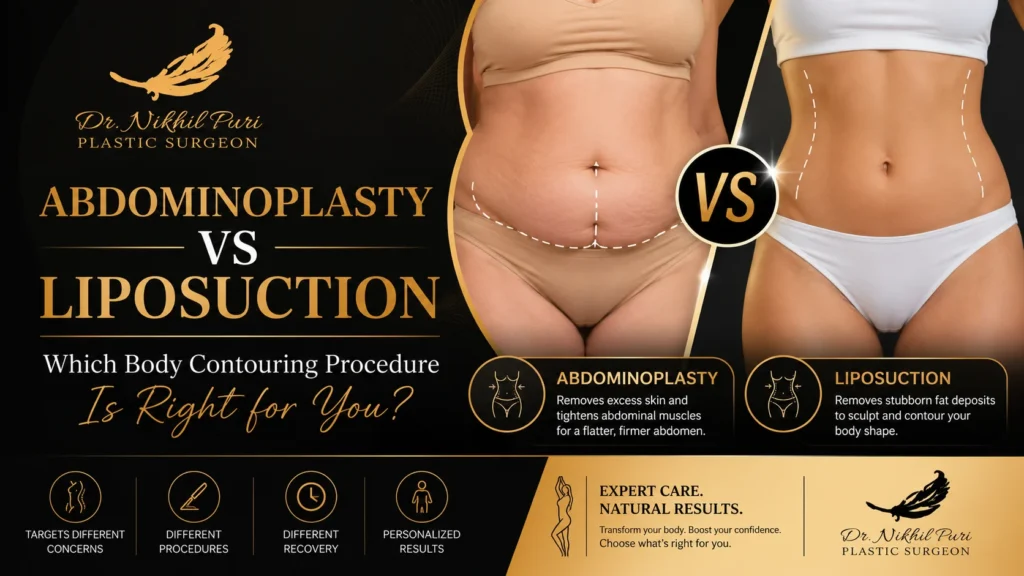
When diet and exercise aren’t enough to achieve a flat stomach, many patients find themselves weighing the pros and cons of Abdominoplasty vs Liposuction. Whether you are dealing with localized fat pockets or the “hanging” skin often left behind after pregnancy or weight loss, choosing the right procedure is key. This guide will help you navigate the differences between these two body contouring giants to find the perfect fit for your anatomy.
Should You Choose Liposuction or Abdominoplasty?
Choosing the right body contouring procedure is a significant decision for anyone looking to refine their silhouette. Many individuals struggle with stubborn midsection concerns that diet and exercise simply cannot resolve. Consequently, they often find themselves torn between two popular surgical options.
These procedures offer transformative results, yet they address fundamentally different anatomical issues. While one focuses on fat volume, the other targets structural integrity and skin laxity. Understanding these nuances is the first step toward your transformation.
If you are considering Liposuction in Lucknow, you are likely looking for a way to sculpt specific areas. However, if your primary concern is sagging skin or a protruding “pooch” caused by muscle separation, another path might be better.
Why Are These Two Procedures Often Confused?
Patients often confuse these surgeries because both aim to improve the appearance of the midsection. They both result in a slimmer, more defined profile. Furthermore, both procedures are frequently part of a comprehensive “Mommy Makeover” plan.
Despite these similarities, the surgical approach varies significantly. Liposuction is minimally invasive compared to the more extensive nature of a tummy tuck. Many patients assume that if they have a large stomach, they only need fat removal. In reality, the presence of loose skin can make fat removal alone look unsatisfactory.
Dr. Nikhil Puri, a renowned expert in plastic surgery, emphasizes that clarity is key. Patients must distinguish between “weight” and “shape” to choose the right surgical intervention.
Which Procedure Delivers Better Body Contouring Results?
Neither procedure is inherently “better” than the other in a general sense. Instead, the “better” option is the one that directly addresses your specific physical concerns.
Liposuction delivers exceptional results for those with good skin tone who want to eliminate fat pockets. Conversely, abdominoplasty provides a dramatic transformation for those dealing with the aftermath of pregnancy or massive weight loss.
When you select the correct procedure, the results can be life-changing. Your clothes will fit better, and your self-confidence will likely soar. The goal of any body contouring surgery is to create harmony between your physical appearance and your internal sense of self.
What Is Liposuction Surgery and How Does It Work?
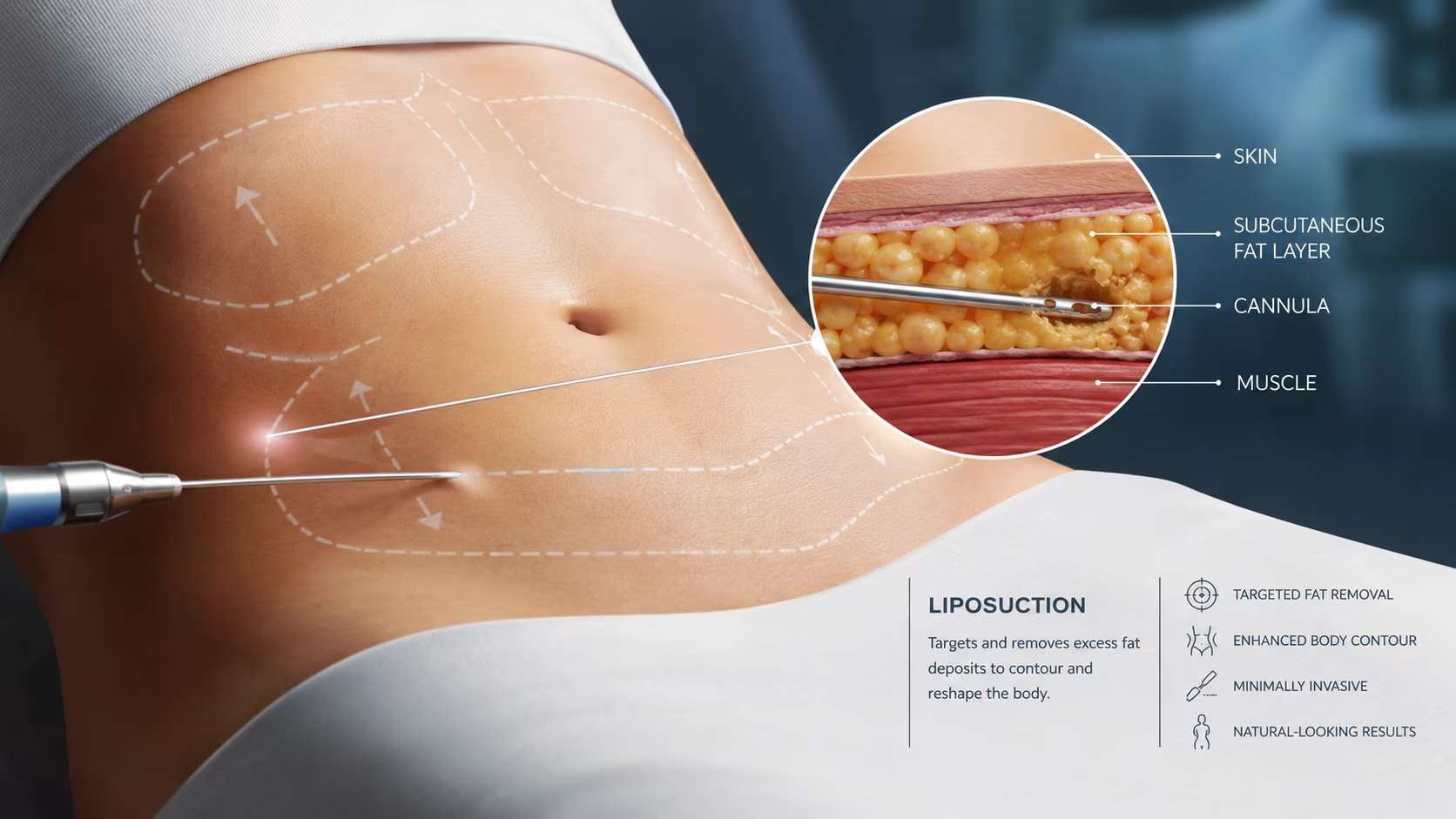
Liposuction Surgery is a popular cosmetic procedure designed to reshape and slim specific areas of the body. It specifically targets subcutaneous fat, which is the fat located just beneath the skin.
During the procedure, a surgeon makes tiny, inconspicuous incisions in the target area. They then insert a thin tube called a cannula. This device breaks up the fat cells, which are then vacuumed out of the body.
Modern techniques, such as tumescent or ultrasound-assisted liposuction, have made the process safer and more precise. These advancements allow for smoother results and reduced bruising. It is important to note that this is a sculpting tool, not a weight-loss method.
What Areas Can Be Treated With Liposuction?
Liposuction is incredibly versatile. While the abdomen is a common site, it can also treat the hips, thighs, arms, and even the neck. Many patients use it to eliminate “love handles” or “saddlebags” that persist despite a healthy lifestyle.
Because the incisions are so small, the scars are usually barely visible. This makes it an attractive option for those wanting subtle yet impactful changes. The procedure can also be used to enhance the results of other surgeries.
Who Is an Ideal Candidate?
An ideal candidate for liposuction is someone within 30% of their ideal body weight. They should have firm, elastic skin that will “snap back” once the underlying fat is removed.
Nonsmokers with realistic expectations generally see the best outcomes. If your skin is very thin or lacks elasticity, removing fat may leave you with sagging or “crepy” skin. In such cases, a different approach is often recommended.
What Results Can You Expect?
After the initial swelling subsides, you will notice a more contoured and streamlined appearance. The fat cells removed during the surgery are gone permanently. However, maintaining these results requires a stable weight.
If you gain weight after the procedure, the remaining fat cells in your body can still expand. Therefore, a commitment to a healthy diet is vital. Most patients report feeling more motivated to stay fit after seeing their new shape.
What Is Abdominoplasty Surgery?
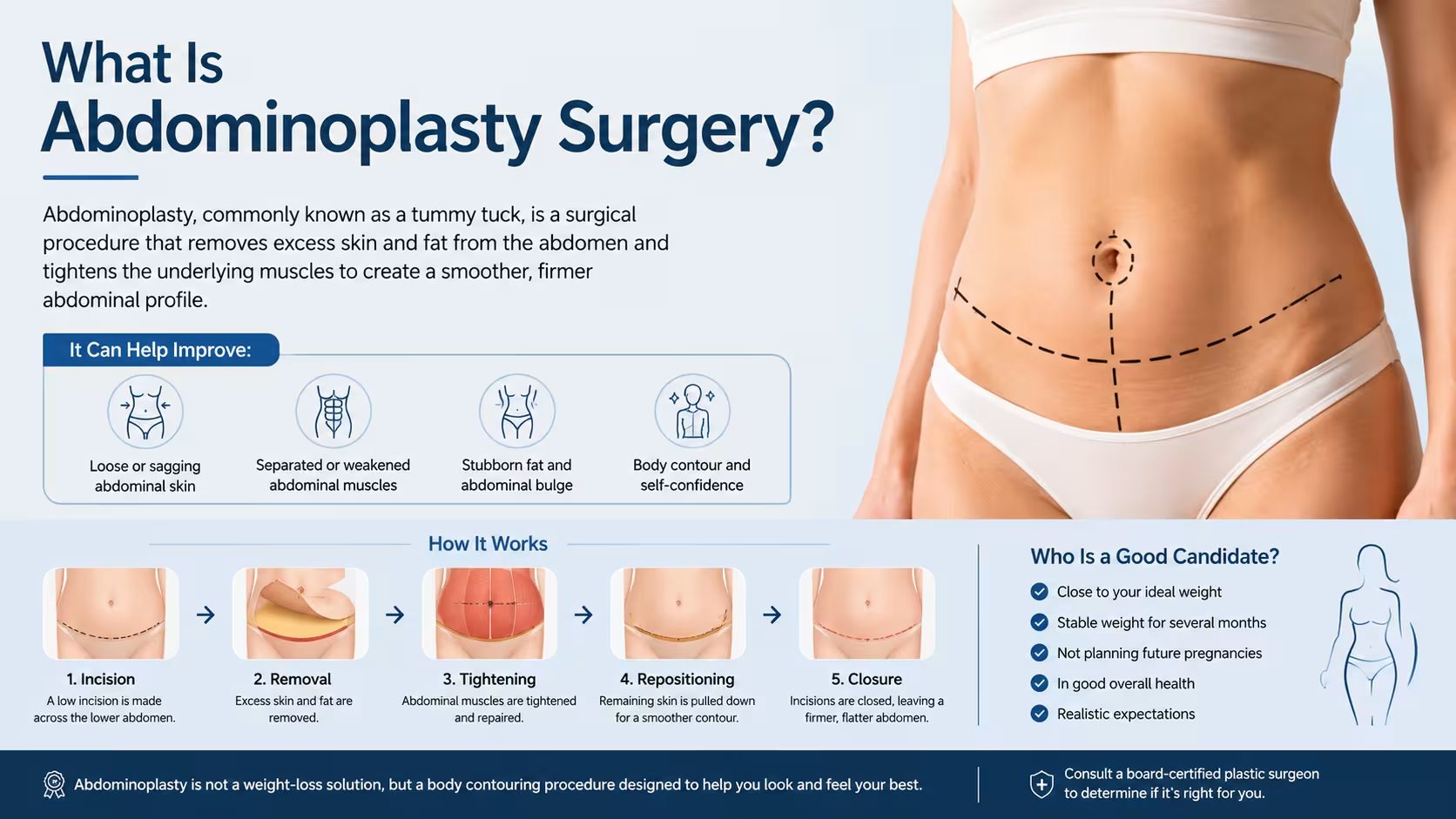
Abdominoplasty Surgery, commonly known as a tummy tuck, is a more comprehensive procedure than liposuction. It addresses three main issues: excess skin, stubborn fat, and separated abdominal muscles.
During this surgery, the surgeon makes a horizontal incision between the pubic hairline and the belly button. The shape and length of the incision depend on the amount of excess skin. The surgeon then repairs the underlying muscles and pulls the remaining skin taut.
This procedure is especially effective for correcting the “apron” of skin that can develop after pregnancy. It also repositions the navel to a more natural, youthful location. It provides a structural overhaul that fat removal alone cannot achieve.
How Does a Tummy Tuck Differ From Fat Removal?
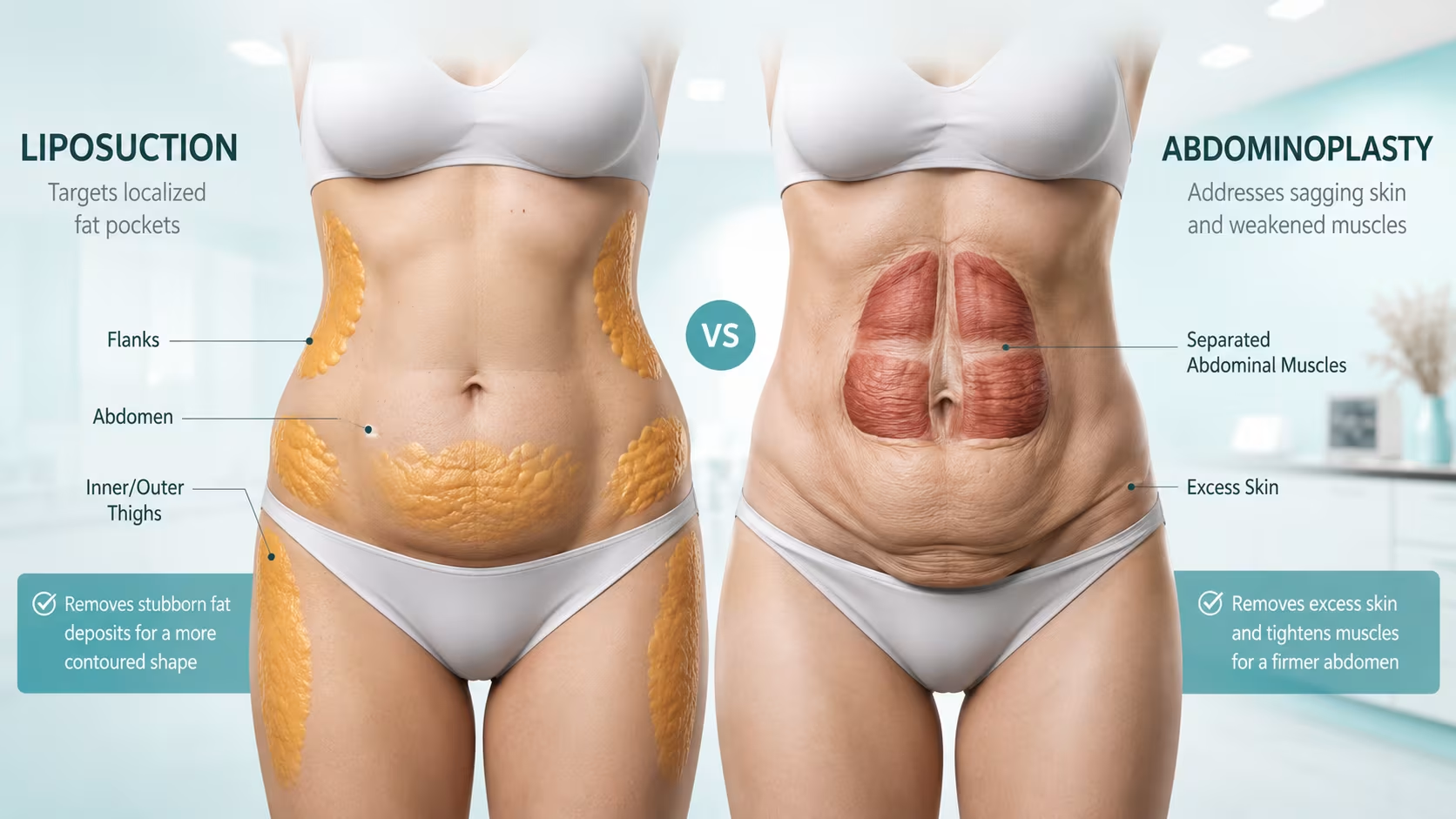
The primary difference lies in the treatment of the skin and muscles. Liposuction only removes fat; it does nothing to tighten loose skin. If you have significant skin laxity, liposuction could actually worsen the appearance of sagging.
Abdominoplasty, however, removes the excess “envelope” of skin. It also addresses diastasis recti, which is the separation of the abdominal muscles. By stitching these muscles back together, the surgeon creates a firm, flat internal corset.
Who Should Consider Abdominoplasty?
You should consider this surgery if you have “loose” skin that hangs over your belt line. It is also the gold standard for women who have finished childbearing and want to restore their pre-pregnancy abdomen.
Furthermore, individuals who have lost a significant amount of weight often find they have empty folds of skin. Exercise cannot tighten this skin because the elasticity has been permanently damaged. Abdominoplasty is the only way to surgically remove this tissue.
What Problems Does It Correct?
Beyond aesthetics, a tummy tuck can improve physical comfort. Removing excess skin can reduce skin irritation and rashes in the folds. Additionally, repairing the abdominal muscles can improve core strength and posture.
Many patients find that their lower back pain decreases after the surgery. This is because a stronger abdominal wall provides better support for the spine. Thus, the benefits are often both cosmetic and functional.
What Is the Difference Between Abdominoplasty and Liposuction?
Understanding the technical differences is crucial for making an informed choice. Liposuction is a fat-focused procedure, whereas abdominoplasty is a skin-and-muscle-focused procedure.
Liposuction uses small punctures, while abdominoplasty requires a longer incision. Consequently, the recovery times and scarring profiles differ significantly. One is about volume reduction; the other is about structural restoration.
Fat Removal vs. Skin Tightening
Liposuction is the “gold standard” for removing localized fat pockets. It creates a smoother silhouette by reducing the thickness of the fat layer. However, it relies entirely on the skin’s ability to contract over the new, smaller frame.
Abdominoplasty is the only solution for redundant, sagging skin. If you can “pinch and pull” your skin away from the muscle, you likely need a tummy tuck. This surgery ensures the skin is tight and smooth across the stomach.
Muscle Repair vs. Body Contouring
Muscle repair is a unique feature of the tummy tuck. Pregnancy and weight fluctuations often stretch the connective tissue between the rectus abdominis muscles. No amount of crunches can fix this internal separation.
Liposuction does not touch the muscles at all. It stays in the fatty layer above the muscle wall. Therefore, if your stomach bulges because of muscle weakness, liposuction will not flatten it.
Surgical Technique Comparison
| Feature | Liposuction | Abdominoplasty (Tummy Tuck) |
| Purpose | Remove stubborn fat | Remove skin & repair muscle |
| Best Candidates | Good skin elasticity, localized fat | Loose skin, muscle separation |
| Incision Size | Tiny (few millimeters) | Long (hip to hip) |
| Fat Removal | High | Moderate (combined with skin) |
| Skin Removal | None | Significant |
| Muscle Tightening | No | Yes |
| Recovery Time | 5–7 days | 2–4 weeks |
| Scarring | Minimal/Hidden | Visible (usually below bikini line) |
| Results | Improved contours | Flatter, tighter abdomen |
| Downtime | Low | High |
Which Procedure Is Better for Belly Fat?
When patients ask about “belly fat,” they are often referring to two different types. Subcutaneous fat is the “pinchable” fat under the skin. Visceral fat is the “hard” fat deep inside the abdomen, surrounding the organs.
Liposuction is excellent for subcutaneous fat. It can effectively thin the layer of fat on top of your muscles. However, it cannot address the fat stored behind the abdominal wall.
Can Liposuction Remove Visceral Fat?
No, liposuction cannot safely remove visceral fat. This type of fat is located around your internal organs and is unreachable by a cannula. Dealing with visceral fat requires lifestyle changes, specifically diet and cardiovascular exercise.
If a patient has a “pot belly” that feels hard to the touch, this is likely visceral fat. In this scenario, neither liposuction nor a tummy tuck will provide a flat stomach. Weight loss must occur before surgery can be considered.
Does a Tummy Tuck Help Reduce Belly Bulge?
Yes, a tummy tuck is very effective at reducing a bulge caused by muscle laxity. Many women have a “pooch” that remains even after they lose weight. This is often due to the muscles being stretched outward.
By tightening these muscles, the surgeon flattens the profile. This creates a much more dramatic change in the “bulge” than fat removal alone could provide. It restores the internal “belt” of the body.
Which Gives a Flatter Abdomen?
For most people with a history of weight change or pregnancy, abdominoplasty gives a flatter result. It removes the two main culprits of a protruding stomach: loose skin and weak muscles.
However, if your only issue is a small, localized fat deposit, liposuction will suffice. The choice depends on what is actually causing the lack of flatness. A physical exam by a surgeon is the only way to know for sure.
Who Is the Right Candidate for Liposuction?
Liposuction is best suited for individuals who are generally healthy but frustrated by specific areas. It is not a solution for obesity or a substitute for a healthy lifestyle.
The best candidates are “stuck” in their fitness journey. They eat well and exercise but cannot lose fat in their midsection or thighs. They have firm skin that will look good once the fat is gone.
Is It Suitable for Weight Loss?
It is a common myth that liposuction is a weight-loss surgery. In reality, the amount of fat removed is usually only a few pounds. The goal is to change the shape of the body, not the number on the scale.
Patients who use liposuction as a weight-loss tool are often disappointed. The most successful patients are those who are already near their target weight. They use the surgery to “fine-tune” their appearance.
What BMI Is Considered Ideal?
Most surgeons prefer a Body Mass Index (BMI) below 30 for the best safety and aesthetic results. A lower BMI generally correlates with less visceral fat and better healing.
If your BMI is over 35, your surgeon may recommend losing weight before the procedure. This reduces the risk of complications like blood clots or poor wound healing. Safety is always the priority in elective cosmetic surgery.
Can Men and Women Both Benefit?
Absolutely. Men often seek liposuction to address “love handles” or fat in the chest area (gynecomastia). Women often target the abdomen, hips, and thighs.
The techniques are essentially the same for both genders. However, the aesthetic goals may differ. Men often want a more “chiseled” look, while women typically seek softer, more curved contours.
Who Should Choose Abdominoplasty Instead?
If you are looking for Abdominoplasty in Lucknow, you are likely seeking a more comprehensive correction. This procedure is the gold standard for those who have experienced significant bodily changes.
People who have lost 50 pounds or more often have “deflated” skin. This skin will not shrink back, regardless of how many abdominal exercises they do. Abdominoplasty is the surgical answer to this problem.
Is It Best After Pregnancy?
Pregnancy significantly alters the abdominal structure. It stretches the skin and often separates the abdominal muscles permanently. For many women, a tummy tuck is the only way to reclaim their pre-pregnancy body.
Wait until you are finished having children before undergoing this surgery. Future pregnancies will likely stretch the muscles and skin again, undoing the results of the procedure. It is an investment in your “forever” body.
Does It Help After Massive Weight Loss?
Yes, it is often the final step in a weight-loss journey. After the hard work of dieting and exercising, loose skin can be a frustrating reminder of the past. Removing this skin helps patients finally see the muscles they worked so hard to build.
It also helps with mobility. Excess skin can be heavy and cumbersome during physical activity. Removing it allows for a more active and comfortable lifestyle.
Can It Repair Separated Abdominal Muscles (Diastasis Recti)?
Yes, this is a core component of the procedure. The surgeon uses permanent sutures to pull the vertical abdominal muscles back together. This creates a firm foundation for the rest of the abdomen.
This repair often leads to a narrower waistline. It also provides functional benefits, such as improved core stability. Many patients find they can perform physical tasks more easily after this repair.
Can Liposuction and Abdominoplasty Be Performed Together?
Many patients find that a combination of both procedures offers the most complete result. This is often referred to as a “Lipo-abdominoplasty.” It allows the surgeon to address skin laxity and fat volume simultaneously.
By performing liposuction on the flanks (sides) while doing a tummy tuck on the front, the surgeon can create a dramatic “hourglass” shape. It provides a level of sculpting that a standard tummy tuck alone might miss.
Who Benefits From Combining Both Procedures?
Patients with both excess skin and significant fat deposits are the best candidates. If a surgeon only performs a tummy tuck, the patient might still have thick fat on their sides. This can lead to an “unbalanced” look.
Combining the two ensures that the entire midsection is addressed. It creates a smooth transition from the front of the abdomen to the hips and back. It is a holistic approach to body contouring.
What Are the Advantages?
The main advantage is undergoing only one surgery and one recovery period. It is more cost-effective than scheduling two separate procedures. Furthermore, the aesthetic outcome is often superior.
The surgeon can better visualize the contours of the body when performing both at once. This leads to more precise fat removal and skin tightening. It is the ultimate “transformative” package.
Does It Increase Recovery Time?
Combining procedures does slightly increase the complexity of the recovery. There may be more initial swelling and a slightly higher level of discomfort. However, most patients find the trade-off to be worth it.
Since you only have to go under anesthesia once, the overall “downtime” from your life is minimized compared to having two separate surgeries months apart. Your surgeon will provide a detailed plan for managing a combined recovery.
What Is the Recovery Process Like?
Recovery is a vital phase of your journey. While your surgeon does the work in the operating room, your body does the work in the weeks following. Following post-operative instructions is non-negotiable for safety.
Compression garments are a staple of recovery for both procedures. These garments help reduce swelling and support the new contours as they heal. They also help the skin adhere to the underlying tissue.
Recovery After Liposuction
Liposuction recovery is relatively quick. Most patients return to light office work within 3 to 5 days. You will experience some bruising and soreness, similar to a very intense workout.
The “final” results take time to appear as the swelling subsides over several weeks. You should avoid strenuous exercise for at least 2 to 3 weeks. Walking is encouraged immediately to promote circulation.
Recovery After Abdominoplasty
A tummy tuck is a major surgery, and the recovery reflects that. Most patients need at least 2 weeks off work. You will likely walk with a slight “hunch” for the first week to avoid tension on the incision.
Pain is managed with medication, and most patients find that the discomfort decreases significantly after the first few days. You will need to wear a binder or compression garment for 6 weeks or more.
When Can You Resume Exercise?
Light walking should begin the day after surgery. However, heavy lifting and core-intensive exercises must wait. For liposuction, you can usually return to the gym in 3 weeks.
For a tummy tuck, you must wait at least 6 weeks before doing any abdominal exercises. Your internal muscle repair needs time to heal fully. Rushing back to the gym can cause complications or ruin your results.
When Will Final Results Be Visible?
While you will see an immediate change, the “final” look takes 6 to 12 months. This is because residual swelling can linger, especially in the lower abdomen.
The scar from a tummy tuck will also take a year or more to fade from red to a thin, silver line. Patience is a virtue in plastic surgery. The best results come to those who allow their body the time it needs to heal.
| Stage | Liposuction | Abdominoplasty |
| Back to Work | 3–5 Days | 2–3 Weeks |
| Walking Daily | Day 1 | Day 1 |
| Gym (Light) | 2 Weeks | 4 Weeks |
| Gym (Heavy) | 4 Weeks | 6–8 Weeks |
| Swelling Gone | 2–3 Months | 6–12 Months |
What Are the Risks and Possible Complications?
Like any surgery, these procedures carry risks. Choosing a board-certified plastic surgeon is the best way to minimize these dangers. They have the training to handle complications should they arise.
General risks include reaction to anesthesia, infection, and bleeding. However, modern surgical environments are designed to keep these risks very low. A thorough pre-operative screening ensures you are healthy enough for surgery.
Common Side Effects
Common side effects include temporary numbness, bruising, and swelling. These are normal parts of the healing process. In liposuction, you might feel temporary “lumps” as the tissue heals.
In abdominoplasty, the area around the incision and the navel may feel numb for several months. Most of this sensation usually returns over time. These side effects are manageable and expected.
Rare Complications
Rare complications include blood clots (DVT), seroma (fluid buildup), or poor wound healing. Smokers are at a much higher risk for skin necrosis (tissue death). This is why surgeons insist on quitting smoking weeks before surgery.
Asymmetry is also a possibility, though a skilled surgeon takes great care to ensure balance. If a seroma occurs, the surgeon may need to drain it with a small needle in the office.
How Can Risks Be Minimized?
The best way to minimize risk is to follow all instructions perfectly. This includes taking your medications, wearing your compression garments, and attending all follow-up appointments.
Furthermore, being honest with your surgeon about your medical history is vital. Mention any supplements or medications you take. Small details can make a big difference in surgical safety.
How Long Do the Results Last?
The results of body contouring can last a lifetime, but they are not “bulletproof.” These procedures remove existing fat and skin, but they do not stop the aging process.
Think of surgery as a “reset button.” You are starting with a new, improved baseline. How you treat your body after the “reset” determines how long the results will stay crisp and defined.
Can Fat Return After Liposuction?
Fat cells do not grow back. Once they are suctioned out, they are gone forever. However, the remaining fat cells in your body can still grow larger if you consume excess calories.
If you gain a significant amount of weight, the fat will likely settle in non-treated areas. For example, if you had liposuction on your stomach, you might notice new weight gain in your back or arms. Consistency in diet is key.
Can Skin Become Loose Again?
Skin can lose elasticity over time due to aging or sun exposure. However, it will never be as loose as it was before the surgery. Maintaining a stable weight is the best way to keep your skin tight.
Significant weight fluctuations after a tummy tuck can stretch the skin again. To protect your investment, aim to stay within 10 to 15 pounds of your post-surgery weight.
How Important Is Diet and Exercise?
Diet and exercise are the pillars of long-term success. Surgery is a tool to change your shape, but lifestyle is the tool to maintain it. Most patients find that their surgical results give them the boost they need to stick to a healthy routine.
Dr. Nikhil Puri believes that the ideal body contouring procedure depends on each patient’s anatomy and lifestyle. He often encourages patients to view surgery as a partnership between the surgeon’s skill and the patient’s commitment.
What Questions Should You Ask Before Choosing Body Contouring Surgery?
Before you commit to surgery, you need to have a clear understanding of your goals. Not every procedure is right for every person. Asking yourself and your surgeon the right questions will lead to a better experience.
Think about what bothers you most when you look in the mirror. Is it the “softness” of the fat, or is it the “hanging” nature of the skin? The answer to that question points toward your ideal surgery.
Is Your Goal Fat Reduction or Skin Tightening?
If you are happy with your skin quality but hate the “bulges,” liposuction is likely the answer. It provides targeted fat reduction with minimal recovery. It is a refinement tool.
If your skin feels like an “empty bag” or hangs over your pants, you need skin tightening. Liposuction alone will leave that skin looking even looser. You must address the “envelope” to see the “contents.”
Are You Planning Future Pregnancy?
This is a critical question for women. While it is safe to have a baby after a tummy tuck, it will likely compromise the results. The muscles will stretch again, and skin laxity may return.
Most surgeons recommend waiting until your family is complete. This ensures that the results of your abdominoplasty remain intact for decades. It is better to do it once and do it right.
Are Your Expectations Realistic?
Plastic surgery can improve your appearance and confidence, but it won’t make you look like a different person. It also won’t solve underlying emotional or relationship issues.
A successful surgery is one where the patient is happy with a “better” version of themselves. Look at “before and after” photos of patients with similar body types to get a realistic idea of what is possible.
How Do You Decide Between Abdominoplasty and Liposuction?
Making the final decision involves a step-by-step assessment of your body. You can even do a preliminary check at home. However, this guide should be used as a conversation starter with your surgeon.
Step 1: Understand Your Body Concerns
Identify if your main issue is volume (fat) or structure (skin/muscle). Look at your midsection from the side. Does it bulge uniformly, or is there a specific pocket of fat you can isolate?
Step 2: Assess Skin Elasticity
Pinch the skin on your stomach and let it go. Does it snap back immediately? If so, you have good elasticity and may be a candidate for liposuction. If it stays “tented” or looks wrinkled, you likely need a tummy tuck.
Step 3: Evaluate Muscle Laxity
Lie flat on your back and try to do a small crunch. Does the middle of your stomach “dome” or “peak” upward? This is a sign of diastasis recti. Only an abdominoplasty can fix this.
Step 4: Discuss Your Goals With a Qualified Plastic Surgeon
Schedule a consultation to get a professional opinion. A surgeon can feel the thickness of the fat and the strength of the muscles in a way you cannot. They will provide a clinical recommendation.
Step 5: Choose the Most Appropriate Treatment Plan
Based on the surgeon’s findings, decide whether to proceed with one surgery or a combination. Consider the recovery time and costs involved. Choose the path that aligns with your long-term vision for your body.
Expert Insights: Why Personalized Body Contouring Delivers Better Results
In the world of cosmetic surgery, there is no such thing as a “standard” body. Every patient has a different bone structure, fat distribution, and skin quality. Therefore, a cookie-cutter approach never works.
Dr. Nikhil Puri emphasizes that the best outcomes happen when the surgeon listens to the patient’s specific insecurities. He believes that the ideal body contouring procedure depends on each patient’s anatomy, skin quality, muscle condition, and cosmetic goals rather than following a one-size-fits-all approach.
By personalizing the surgical plan, the surgeon can ensure the results look natural. The goal is not to look like you had surgery; the goal is to look like you were born with a great silhouette. Personalization is the hallmark of high-quality care.
Why One Procedure Doesn’t Fit Every Patient
Some patients have thick skin and a lot of fat. Others have thin skin and very little fat but significant muscle separation. These two individuals require completely different surgical techniques.
A surgeon who tries to perform the same operation on everyone will eventually produce subpar results. This is why a thorough consultation is the most important part of the process. It is time to build a custom roadmap for your transformation.
Common Myths vs. Facts
There is a lot of misinformation online regarding body contouring. Let’s clear up some of the most common misconceptions to help you make an educated choice.
| Myth | Fact |
| Liposuction is for weight loss. | Liposuction is for body sculpting, not losing weight. |
| Abdominoplasty removes fat only. | It removes skin and repairs muscle; fat removal is secondary. |
| Results last forever regardless. | You must maintain a stable weight to keep your results. |
| Everyone needs both procedures. | Many people achieve their goals with just one or the other. |
| Exercise can fix loose skin. | Exercise builds muscle but cannot shrink stretched skin. |
Key Takeaways
-
Liposuction Removes Fat: It is the best choice for targeted fat reduction in patients with good skin elasticity.
-
Abdominoplasty Removes Excess Skin and Tightens Muscles: It is essential for those with sagging skin or muscle separation.
-
Patient Selection Determines Success: The “right” procedure depends entirely on your specific physical anatomy.
-
Healthy Lifestyle Maintains Long-Term Results: Surgery is a “new beginning,” but your habits determine how long the results last.
-
Consulting an Expert is Vital: Only a qualified surgeon can determine which procedure will safely achieve your goals.
Conclusion
In summary, both Liposuction Surgery and Abdominoplasty Surgery are powerful tools for body transformation. Liposuction focuses on fat, while abdominoplasty focuses on skin and muscle. Neither is superior; they simply solve different problems.
Choosing the correct procedure depends on your body composition and your ultimate treatment goals. A personalized surgical plan, tailored to your unique needs, provides the best aesthetic outcome. Consulting an experienced plastic surgeon helps you make an informed and confident decision.
If you are ready to take the next step in your body contouring journey, expert guidance is just a consultation away. Consult Dr. Nikhil Puri for professional advice and a personalized assessment to discover which procedure is right for you.
FAQs On Abdominoplasty vs Liposuction
Q1.Which is better: Liposuction or Abdominoplasty?
Neither is universally better; the choice depends on your needs. Liposuction is better for removing stubborn fat if you have tight skin. Abdominoplasty is better if you have loose skin or separated muscles. Many patients choose to combine both for the most comprehensive and balanced body contouring result.
Q2.Is Liposuction a weight loss surgery?
No, liposuction is not a weight loss surgery. It is a body contouring procedure designed to remove localized pockets of fat that are resistant to diet and exercise. Ideal candidates are already at or near their target weight and wish to improve their body’s overall shape and proportions.
Q3.Can Abdominoplasty remove belly fat?
While abdominoplasty removes the fat attached to the excess skin being excised, its primary goal is skin removal and muscle tightening. If you have significant fat in the flanks or upper abdomen, your surgeon may recommend combining the tummy tuck with liposuction to achieve a truly flat and contoured stomach.
Q4.Can both surgeries be performed together?
Yes, performing liposuction and abdominoplasty together is very common and often recommended. This combination, sometimes called a “Lipo-abdominoplasty,” allows the surgeon to tighten the skin and muscles while simultaneously sculpting the waist and hips. This holistic approach often yields the most dramatic and aesthetically pleasing results.
Q5.Which surgery has a longer recovery?
Abdominoplasty has a longer and more intensive recovery period than liposuction. While liposuction patients often return to work within a few days, tummy tuck patients usually require two to three weeks of downtime. This is because the tummy tuck involves a larger incision and the repair of the underlying abdominal muscles